



Podcasts
Watch videos featuring supply chain experts




End-to-end compliance automation across classification, screening, and duties.







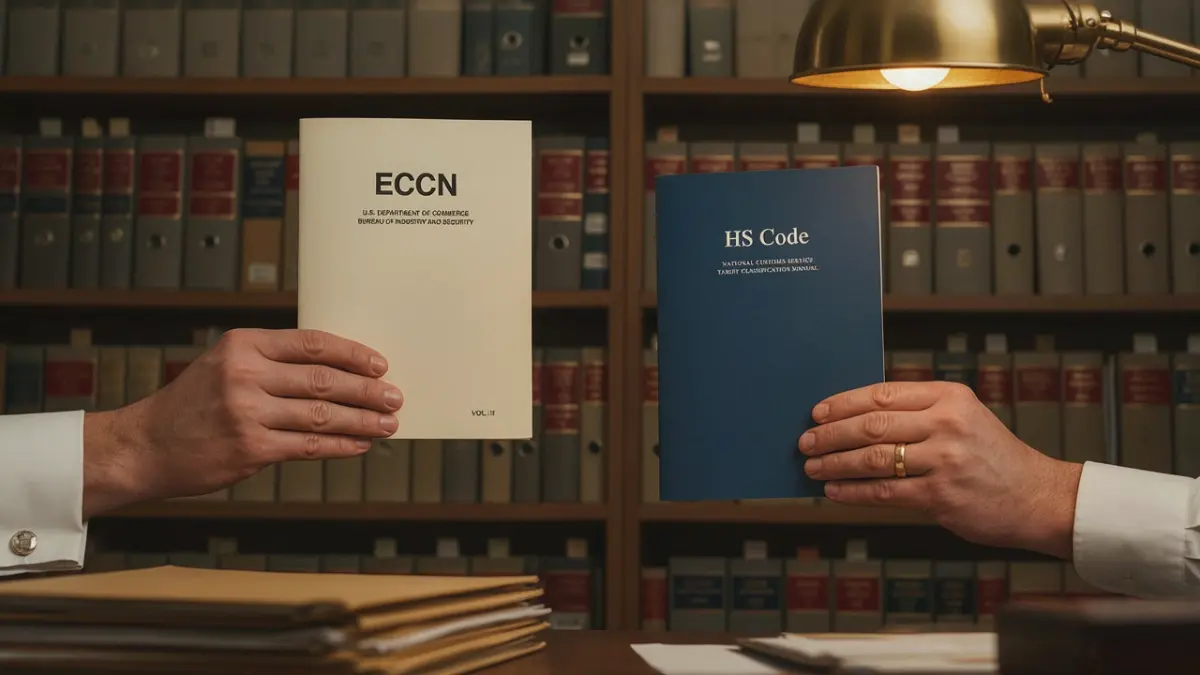


A product can need both an HS code and an ECCN, but the two classifications serve very different purposes.
An HS code is primarily used to classify goods for customs, tariffs, and international trade statistics. An ECCN (Export Control Classification Number) is used under the U.S. Export Administration Regulations (EAR) to identify items subject to specific export controls. The U.S. Bureau of Industry and Security (BIS) explicitly states that an ECCN is distinct from and unrelated to an HS or Schedule B number.
This distinction matters because using an HS code to determine export-control requirements, or treating an ECCN as a tariff classification, can lead to incorrect compliance decisions.
HS codes classify products for customs and tariff purposes. ECCNs classify certain products for export-control purposes.
| <br> | HS Code | ECCN |
|---|---|---|
| Full name | Harmonized System code | Export Control Classification Number |
| Primary purpose | Customs, tariffs, trade statistics | Export controls and licensing |
| Managed by | World Customs Organization framework, implemented nationally | U.S. Department of Commerce/BIS for the U.S. EAR |
| Typical format | 6 digits internationally, with countries adding further digits | 5-character alphanumeric code, such as 3A001 |
| Main question answered | "What product is this for customs purposes?" | "Is this item specifically controlled for export purposes?" |
| Determines | Tariff treatment and customs classification | Export-control status and potentially license requirements |
| Applies globally? | HS is used internationally | ECCN is specific to the applicable export-control regime |
| Example | 6-digit HS classification | 3A001 |
| Can one product have both? | Yes | Yes |
The WCO describes the HS as a six-digit international nomenclature used by more than 200 countries and economies as a basis for customs tariffs and trade statistics. BIS defines ECCNs as five-character alphanumeric designations used on the Commerce Control List to identify items for export-control purposes.
An HS code, or Harmonized System code, is a standardized classification used to identify goods in international trade.
The Harmonized System is maintained by the World Customs Organization (WCO). It contains thousands of commodity groups, each identified at the international level by a six-digit code. Countries use this framework as the basis for their national tariff schedules.
For example, a product may be classified into an HS heading and six-digit subheading, after which a particular country may extend that classification with additional digits for its national tariff and statistical requirements.
HS classification can affect:
The exact tariff treatment depends on the importing country's tariff schedule and applicable rules.
The WCO also provides classification tools such as Explanatory Notes, Classification Opinions, and Classification Decisions to support interpretation of the HS.
An ECCN, or Export Control Classification Number, is a U.S. export-control classification used under the Export Administration Regulations (EAR).
BIS describes an ECCN as a five-character alphanumeric designation used on the Commerce Control List (CCL). An ECCN categorizes an item according to factors such as the type of commodity, software, or technology and its technical parameters.
An ECCN can help determine:
Importantly, an ECCN by itself does not determine whether every export requires a license. BIS explains that license analysis also involves factors such as destination, end user, and end use.
A typical ECCN has a structure such as 3A001.
The first character identifies the broad product category, while the second character identifies the product group. The remaining digits identify the specific CCL entry.
If an item is subject to the EAR but is not described by an ECCN on the CCL, it may instead fall under EAR99.
The simplest way to remember the distinction is:
HS classification is primarily about customs. ECCN classification is about export controls.
Consider an electronics manufacturer exporting a processor.
The HS classification helps customs authorities determine how the product should be classified for tariff and customs purposes.
The ECCN classification, where applicable under the EAR, examines the product's technical characteristics against the Commerce Control List to determine its export-control classification.
These are separate classification exercises. A product can therefore have an HS code and an ECCN at the same time.
One of the most common misconceptions is that an HS code can be converted directly into an ECCN.
It cannot.
BIS explicitly states that ECCNs are "distinct from and entirely unrelated to" HS and Schedule B numbers.
The reason is that the classification systems evaluate products for different regulatory purposes.
HS classification generally focuses on the nature and characteristics of merchandise within the customs nomenclature.
ECCN classification can depend heavily on technical characteristics and parameters relevant to export controls.
For some technology products, seemingly small technical differences can affect the applicable export-control classification.
The information needed for each classification can overlap, but the decision process is different.
The WCO provides the international framework, while individual customs authorities administer their national tariff schedules.
BIS specifically notes that ECCNs categorize items based on their nature and technical parameters.
This is why simply searching a product description may not be sufficient for either classification, particularly for technically complex products.
Potentially, yes.
If a company imports or exports physical goods, it may need an HS classification for customs purposes. If the goods are subject to an export-control regime such as the U.S. EAR, the company may separately need to determine the appropriate export-control classification.
The two classifications can coexist in the same product master.
For example:
Product: High-performance electronic component
BIS's export clearance requirements illustrate this distinction by treating the ECCN and the Schedule B or HTS number as separate pieces of export information.
Imagine a manufacturer sells a specialized electronic device internationally.
The compliance team needs to answer two different questions.
The team determines the appropriate HS classification based on the product's characteristics and the applicable tariff nomenclature.
That classification can then feed into customs declarations and tariff analysis.
If the transaction is subject to the U.S. EAR, the team separately determines whether the product is described by an ECCN on the CCL.
The team may then need to evaluate the ECCN's reasons for control against the destination and consider end-user and end-use restrictions.
The HS classification does not answer Question 2.
Likewise, the ECCN does not replace the HS classification needed for customs purposes.
These terms are sometimes mixed together, but they represent different concepts.
A customs classification used within the Harmonized System.
A classification for items specifically described on the U.S. Commerce Control List under the EAR.
A designation for items subject to the EAR that are not described by an ECCN on the CCL.
EAR99 does not mean that an item is automatically free from export restrictions. Other EAR requirements, including restrictions involving destinations, end users, or end uses, can still matter.
The classifications are different, but they often belong to the same product compliance workflow.
A global manufacturer may have thousands of SKUs, with each product requiring different classification and regulatory decisions.
Keeping HS and ECCN data connected can help teams:
This becomes particularly important when product catalogs contain electronics, machinery, software, aerospace components, chemicals, or other products that may have export-control implications.
AI can reduce the manual effort involved in classification, but the underlying regulatory logic still matters.
A useful classification workflow can combine:
Trademo Global Trade Management platform supports separate AI-powered HS and ECCN classification workflows. Its product information states that the HS workflow uses AI-guided classification, structured questionnaires, country-specific tariff schedules, and customs rulings, while its ECCN workflow analyzes products against export-control regulations and technical specifications.
Trademo also describes audit-ready justification and human-in-the-loop review for classification decisions.
For companies managing large product catalogs, keeping classification data in one structured record can make compliance easier to manage.
A product record might contain:
| Data point | Purpose |
|---|---|
| Product description | Identifies the product |
| Technical specifications | Supports classification decisions |
| HS code | Customs and tariff classification |
| ECCN | Export-control classification where applicable |
| Country-specific tariff code | Supports local customs requirements |
| Classification rationale | Documents why the decision was made |
| Regulatory references | Supports the classification |
| Review status | Shows whether expert approval is required |
| Decision history | Provides an audit trail |
| Product change information | Helps identify when reassessment may be necessary |
Trademo's Product Master is designed to centralize product-level compliance information, including HS/HTS codes, ECCN codes, country-specific tariff codes, compliance flags, and related metadata.
It does not. BIS explicitly treats them as separate classification systems.
An ECCN is an export-control classification, not a customs tariff classification.
Products subject to the EAR but not specifically described on the CCL may be EAR99.
EAR99 does not eliminate the need to evaluate applicable export restrictions, including destination, end-user, and end-use requirements.
Product descriptions can be incomplete, and technically complex products often require deeper analysis of specifications and regulatory criteria.
Products, tariff schedules, export-control rules, and regulatory requirements can change. Classification governance should therefore include a process for reviewing changes.
For organizations managing hundreds or thousands of products, a practical approach is:
Maintain descriptions, technical specifications, bills of materials where relevant, and other classification inputs in a controlled product record.
Apply the applicable HS rules and national tariff requirements to determine the customs classification.
For transactions subject to the relevant export-control regime, determine whether the product falls under an ECCN or another applicable designation.
Classification alone may not answer every compliance question. Consider destination, end user, end use, licensing requirements, and other applicable restrictions.
Maintain the rationale, regulatory references, supporting product information, and review history.
Reassess classifications when product specifications or relevant regulatory requirements change.
This approach separates the two classification questions while keeping them connected operationally.
HS codes and ECCNs answer different compliance questions.
For companies with large product catalogs, the practical goal is not to choose between HS and ECCN classification. It is to manage both classifications as distinct but connected parts of the product compliance lifecycle.