




Podcasts
Watch videos featuring supply chain experts




End-to-end compliance automation across classification, screening, and duties.







The global supply chain has a new failure mode. Disruption used to mean physical events: a blocked canal, a congested port, a strike. But the critical mineral chains feeding steel, batteries, and defense are extraordinarily concentrated, and the governments sitting on that concentration now use trade policy itself as the instrument of leverage. Export bans, quotas, royalties, sanctions, and ownership rules move these markets more than weather ever did. Every one of those instruments is published as a structured, dated, product specific document before it changes a landed cost, yet most teams still consume them as news and react after the price moves. Nickel is the sharpest case study in the world today.
Roughly two thirds of nickel demand goes into stainless steel; the rest spreads across superalloys for jet engines, plating, specialty chemicals, and increasingly the cathodes of lithium ion batteries, where nickel rich chemistries deliver the range that electric vehicles depend on. The market splits into Class 1 refined nickel, the exchange traded grade pure enough for batteries, and Class 2 products such as ferronickel that feed stainless mills.
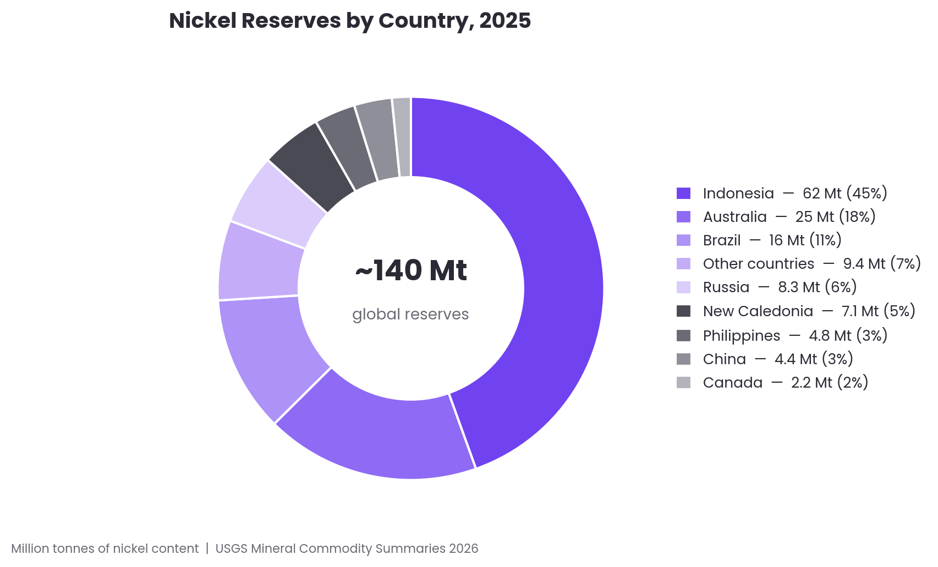
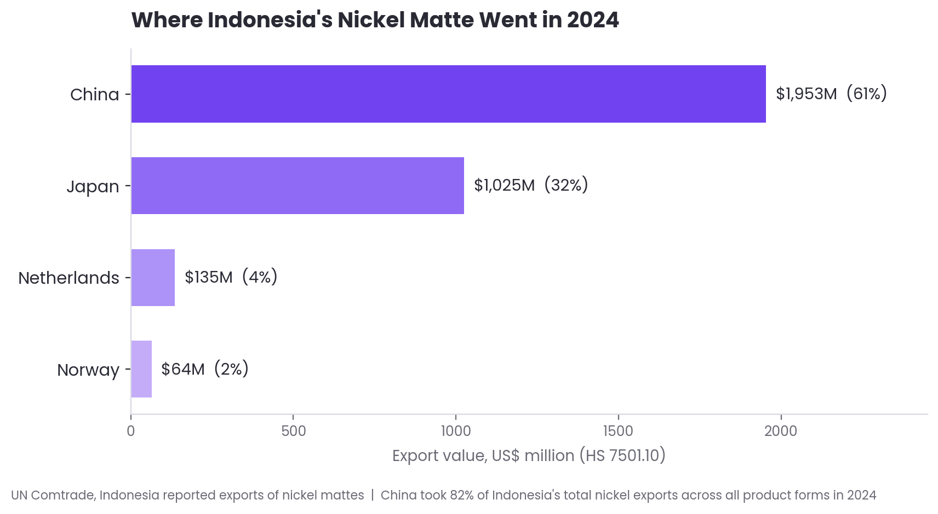
Of roughly 140 million tonnes of global nickel reserves, Indonesia alone holds 62 million, about 45 percent. Australia holds 25 million, Brazil 16 million, Russia 8.3 million. Production is even more skewed: Indonesia mined 2.6 million of the world's 3.9 million tonnes in 2025, and China bought 82 percent of Indonesia's nickel exports in 2024. When one country controls the ground, another controls the demand, and both sit outside your jurisdiction, the pipeline between them is where supply risk actually lives.
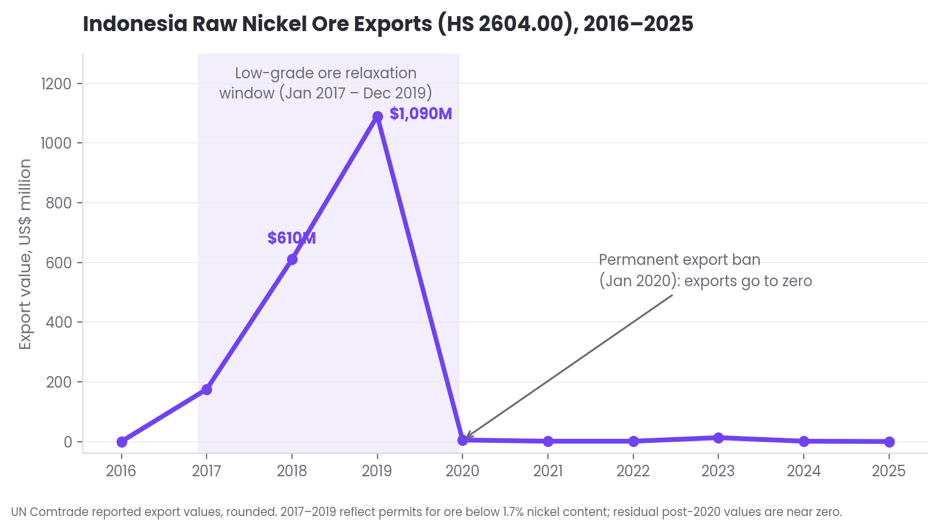
One chart captures Indonesia's conversion of geology into leverage. It banned raw ore exports in 2014, permitted low grade ore between 2017 and 2019, then shut the door permanently in January 2020. Exports of HS 2604.00 surged past a billion dollars during the relaxation window, then went to zero by decree and have stayed there for six years, through a WTO ruling against the ban that Indonesia appealed into a paralyzed Appellate Body. A billion dollar trade lane, administratively deleted.
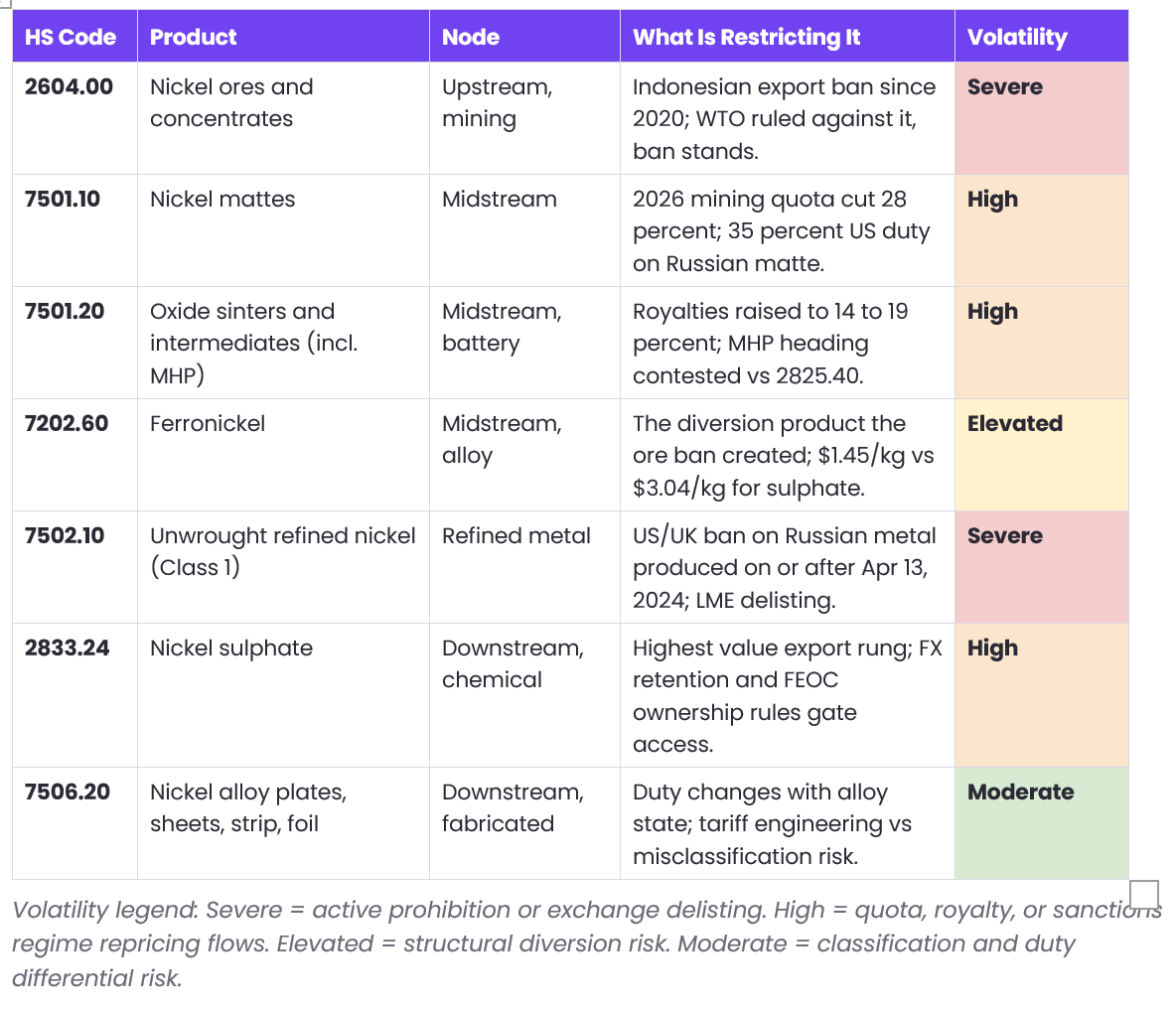
Trade policy never restricts "nickel" in the abstract; every instrument attaches to a tariff line. The analysis therefore tracks one code per value chain node where a distinct policy bites: 2604.00 raw ore (export bans), 7501.10 mattes and 7501.20 intermediates (quotas, royalties, classification disputes), 7202.60 ferronickel (the diversion product), 7502.10 unwrought refined metal (sanctions), 2833.24 nickel sulphate (ownership gated market access), and 7506.20 wrought alloys (duty differentials). Together they cover raw, intermediate, and unwrought states end to end; a policy shock anywhere in the chain must land on at least one.
Shock one: the origin squeezes. The ban forced anyone wanting Indonesian nickel to build smelters onshore. Indonesia's share of mined supply passed 60 percent and its nickel export value rose from about $3 billion to more than $30 billion. With dominance secured, the instruments matured: a 2026 quota of 270 million wet tonnes, down 28 percent, royalties lifted to a price linked 14 to 19 percent, 190 permit suspensions, and a one year foreign exchange retention rule. The global balance flipped from a forecast 283,000 tonne surplus to a 32,000 tonne deficit and the LME rallied 37 percent in a quarter.
Shock two: the sanctions cut. In April 2024 the US and UK prohibited imports of Russian nickel produced on or after April 13, 2024, and the LME and CME stopped accepting it. Tradability now depends on a production date, an attribute customs systems never captured. And the rules leak: Russian nickel refined in Finland legally becomes Finnish, and over a billion dollars of it has kept flowing west. Screening only for origin is compliance on paper.
Shock three: the alternatives fail to flex. The Philippines passed its own export ban in February 2025, withdrew it four months later, and saw output fall 24 percent anyway; Australian production collapsed 54 percent as mines shut on crushed prices. Long contracts, qualification cycles, and smelter dependencies mean volumes hold, then break in drops of a quarter to half of baseline.
The system compresses into seven lines. Read top to bottom, the matrix retells the cascade; the accompanying Excel workbook extends each row with tariff exposure, computed trade deltas, a policy timeline, and the full source register.
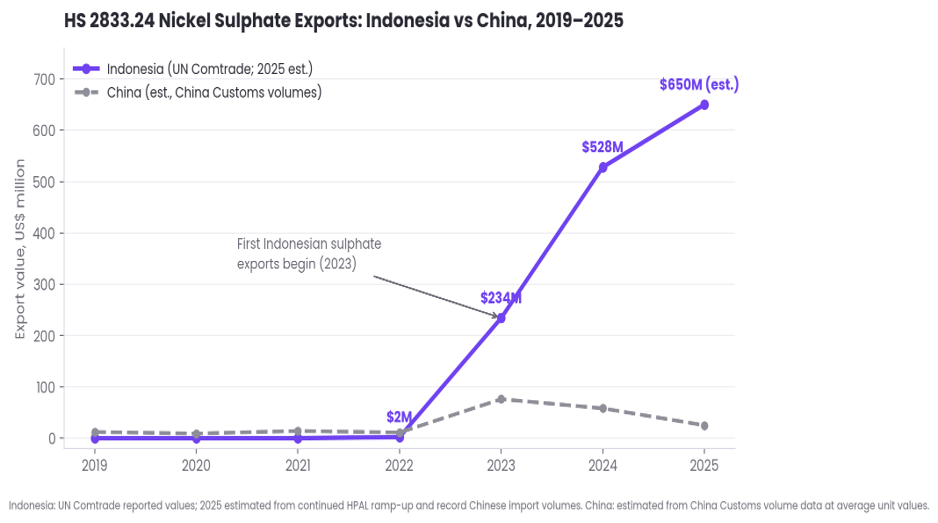
The matrix calls nickel sulphate Indonesia's highest value export rung, and one chart proves it. Through 2022 Indonesia exported essentially none; then its HPAL plants came online and reported exports went from $2 million in 2022 to $234 million in 2023 to $528 million in 2024, with 2025 estimated around $650 million as capacity kept ramping. China's line stays flat for a structural reason: its sulphate feeds its own precursor and cathode industry, so China trades as the world's largest importer of this heading, over $700 million in 2024, much of it now from Indonesia. A brand new, high value trade lane, created entirely by policy, pointed straight at the battery supply chain.
Classification and tariff engineering. All seven HS codes belong in a governed item master with country specific tariff extensions, contested headings flagged against ruling libraries, and duty outcomes modelled across alloy states, so the unwrought versus wrought decision is a computed choice rather than a broker's guess. Sanctions and denied party screening. Russian nickel flags demand a composite match: counterparty lists, origin, production date captured from mill certificates, and ownership graph screening that catches Russian owned metal traveling on a Finnish passport, or Chinese controlled Indonesian sulphate that fails clean vehicle credit rules. Landed cost and diversion modelling. The true cost of shifting procurement toward the Philippines or Australia is a simulation that ingests royalties as a cost floor, benchmark prices as the valuation basis, and applied tariffs per lane, then stress tests each alternative against policy whiplash, idled capacity, and requalification lead times. Connectivity and origin tracing. Electronic customs filing pushes resolved classification and origin data straight into declarations, while digital supply chain ledgers chain custody from mine through every transformation, turning substantial transformation calls into documented decisions with evidence attached.
What does one shipment of HS 2833.24 actually cost to land? The comparison below holds everything constant except origin and trade agreement treatment, under a deliberately clean set of assumptions: the shipment is valued on an FOB basis with a $1 million incoterm value, so freight, insurance, destination freight, and destination charges are all set to zero, and duties are computed at current US default rates for this heading. Three outcomes emerge. From China, the entry attracts $32,000 of import duty, $614.35 MPF, $1,250 HMF, and a $250,000 Section 301 tariff, for a total landed cost of $1,283,864. From Indonesia without preferential treatment, the identical shipment escapes Section 301 and lands at $1,033,864. And where Indonesian origin qualifies under an FTA, the base duty falls away as well, landing at $1,001,864. The side by side calculation, run in Trademo's Landed Cost Calculator, is shown below.
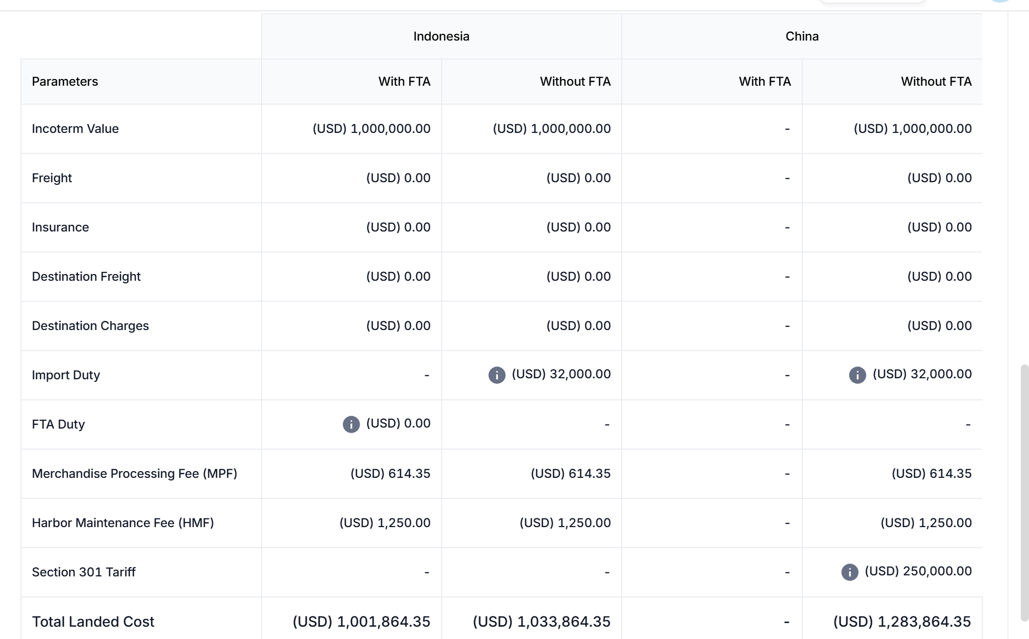
A spread of $282,000, 28 percent of shipment value, decided before the vessel sails, by two data fields: origin and preference eligibility. Origin, classification, and policy are not paperwork that follows a sourcing decision; they are the sourcing decision.
Every shock in this story shares one property: it was visible before it was expensive. The quota decree, the royalty regulation, the sanctions determination, the Philippine bill and its withdrawal, all of them entered the public record as structured, dated, product specific documents before a single price moved or a single container was held. The information asymmetry in critical minerals is no longer between those who have data and those who do not. It is between organizations whose trade data lives in spreadsheets, brokers' inboxes, and quarterly reviews, and organizations whose classification, screening, costing, and regulatory monitoring run on one connected platform where a new measure arrives as a data event with its cost consequences already computed.
Resource nationalism is not going away; nickel is simply the template that lithium, copper, and rare earth producers are already studying. The durable advantage, then, is not predicting which government moves next. It is building the trade intelligence infrastructure that makes any move legible within hours: the joins between HS code and policy instrument, policy instrument and landed cost, landed cost and sourcing decision. Companies that maintain those joins experience the next decree as a repricing event. Companies that do not will read about it in the news, which is exactly where this problem started.